

FUNDED TRADER MARKETS
Funded Trader Markets review covering trading rules, funding options, platforms, profit splits, and key pros and cons for traders.
FUNDED TRADER MARKETS
Funded Trader Markets review covering trading rules, funding options, platforms, profit splits, and key pros and cons for traders.
AI Summary
Funded Trader Markets is a global prop firm offering funded accounts up to $800K, with scaling potential to $3M. Key Features Supports 1-Step, 2-Step, and Instant Funding paths, with profit splits up to 100% (1-Step) and 80% (2-Step/Instant). Platforms include MT5, cTrader, and TradeLocker. Features flexible rules like weekend trading allowed, trailing drawdowns, and consistency caps, with on-demand and fast payouts (“24 Hours or We Pay Double”). ## Pros and Cons | Aspect | Pros | Cons | |-------------|---------------------------|-------------------------------| | Payouts | Fast, on-demand, 24-hour guarantee | Profit retention rules in some accounts | | Platforms | MT5, cTrader, TradeLocker, diverse assets | Some exotic instruments not supported | Rules |Weekend trading, clear drawdowns | Daily consistency limits restrict aggressive trades
About FUNDED TRADER MARKETS
Funded Trader Markets (FTM) positions itself as a modern and flexible proprietary trading firm that combines education, technology, and funded trading opportunities to help traders grow their skills and access capital. According to its official website, FTM operates in over 140 countries, offering global accessibility to traders of various backgrounds.
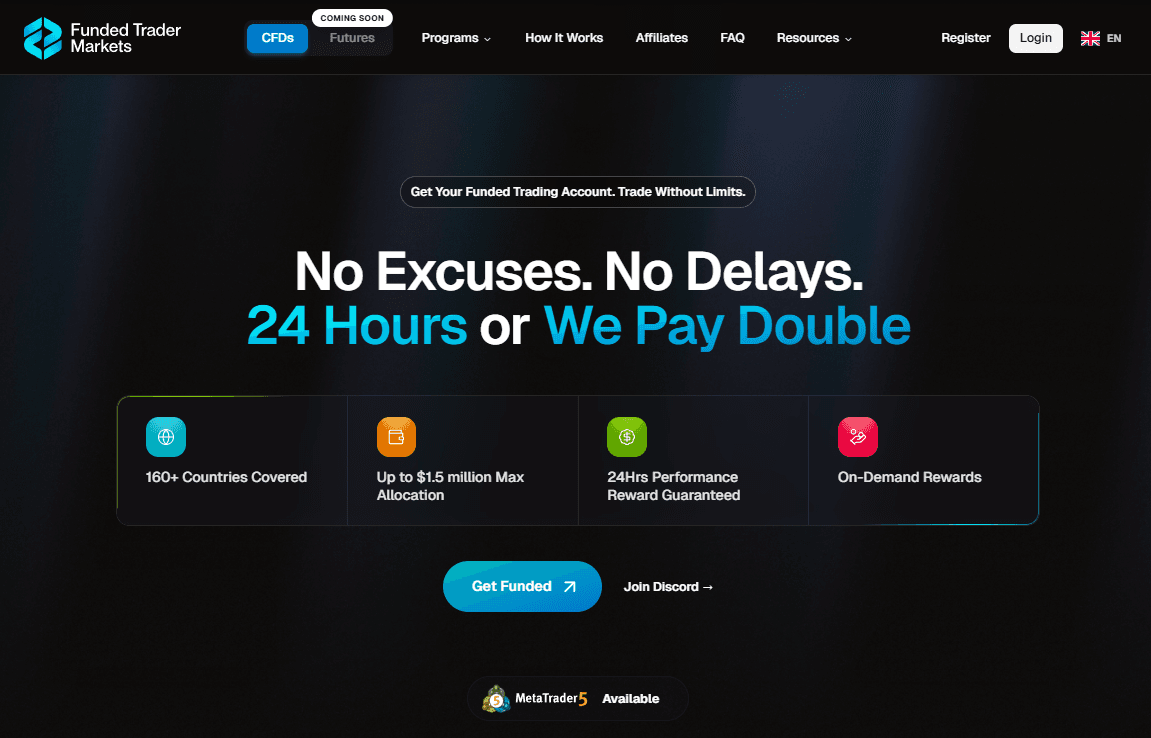
A standout feature of FTM is its emphasis on fast and flexible payouts. The firm promotes a “24 Hours or We Pay Double” policy for withdrawals, highlighting its commitment to rapid profit access once traders meet withdrawal criteria. Additionally, FTM supports on-demand payouts, allowing traders to request withdrawals at any time rather than waiting for fixed cycles offering greater control over earnings.
FTM’s funding model includes both evaluation-based and instant funding options. Traders can choose from three distinct paths:
- 1-Step Evaluation
- 2-Step Evaluation
- Instant Funding
Each path comes with its own profit targets, drawdown rules, and account parameters, clearly outlined on the firm’s Programs page.
Overall, FTM’s value proposition centers on flexibility, transparency, and speed. With generous profit splits, no time limits, and scaling potential, the firm appeals to serious traders seeking a streamlined and supportive environment to grow their trading careers.
Funding Programs: Breakdown of FTM’s Three Main Paths
A key strength of Funded Trader Markets (FTM) is the variety of funding paths. On their official “Programs” page, FTM divides its offerings into 1-Step Evaluation, 2-Step Evaluation, and Instant Funding. Below is a detailed look at each — how they work, who they’re designed for, and what the official FTM rules specify.
1-Step Evaluation: Fastest Path to Funding
The 1-Step Evaluation is designed for traders who want to complete their assessment in a single phase and quickly transition to a funded account. FTM markets this as a “fast track” route, ideal for confident and experienced traders.
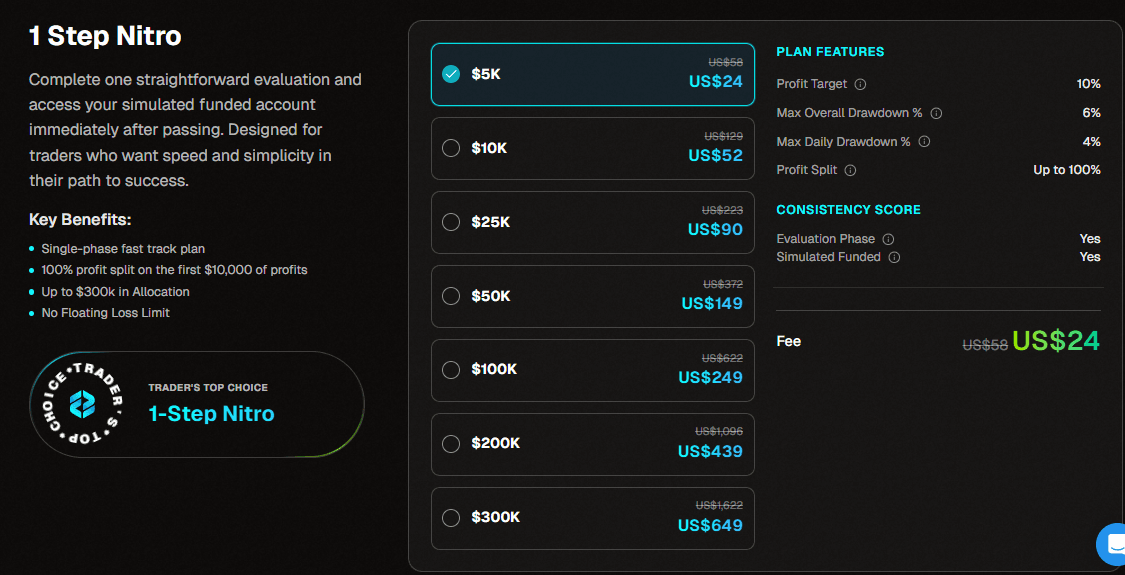
Within the 1-Step model, there are three tiers with distinct risk and reward profiles:
Nitro – The Standard 1-Step Evaluation
- Profit Target: 10%
- Maximum Daily Drawdown: 4% of the initial balance (e.g., $4,000 on a $100,000 account)
- Maximum Overall Drawdown: 6% trailing from the highest balance
- Consistency Rule: Max 50% of the profit target per day during evaluation; 45% in the simulated funded phase
- Minimum Trading Days: 5 simulated trading days required before payout eligibility
- Profit Split: Up to 100% on initial profits
- Scaling: Funding can scale up to $800,000 for qualifying accounts
Nitro Pro – Cost-Efficient, Risk-Sensitive Option
- Profit Target: 8%
- Maximum Daily Drawdown: 2% of the initial balance
- Maximum Overall Drawdown: 3% trailing from the highest balance; locks to initial balance after 3% profit
- Consistency Rule: Max 20% of the profit target per day in both evaluation and simulated funded phases
- Profit Split: Up to 100% on initial profits
- Activation Cost: Lower than Nitro, making it attractive for risk-conscious traders
Nitro X – Lowest Target, Flexible Structure
- Profit Target: 6%
- Maximum Daily Drawdown: 3% of the initial balance
- Maximum Overall Drawdown: 3% trailing from the highest balance; locks after hitting the profit target
- Consistency Rule: Looser in simulated funded phase — capped at 25% of the 6% target per day
- Minimum Trading Days: 5 simulated trading days required
- Activation Fee: Starts at $125 for select account sizes
- Profit Split: Up to 100%, consistent with other 1-Step tiers
2-Step Evaluation: A More Traditional, Two-Phase Path
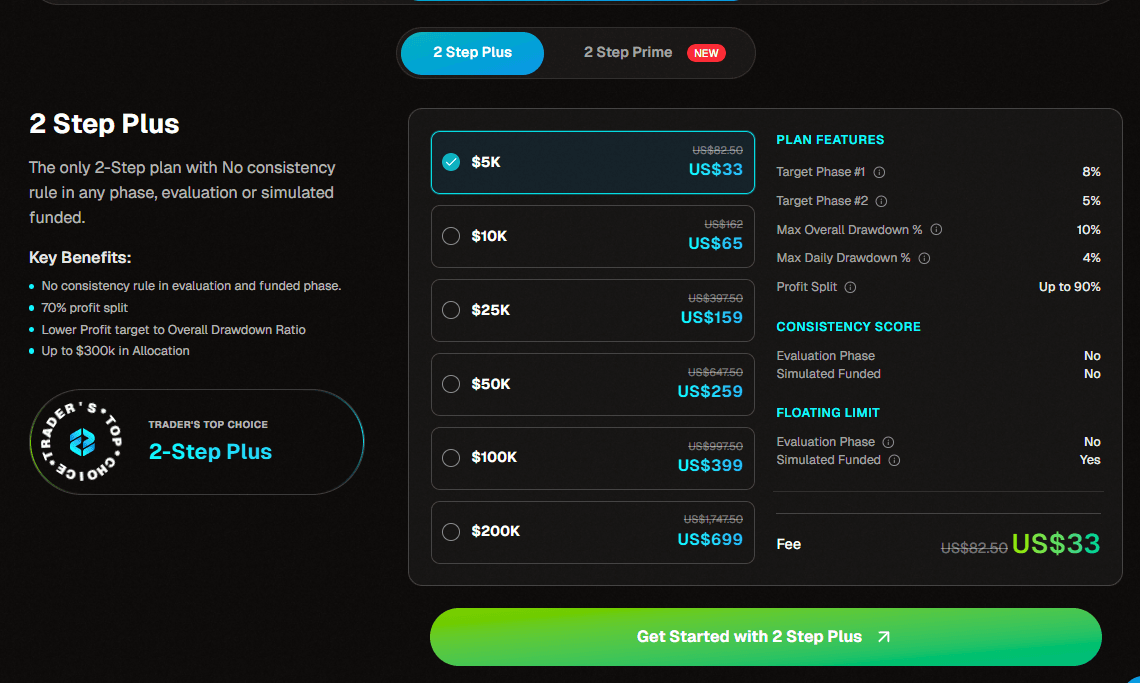
While the 1-Step program offers a fast-track route, Funded Trader Markets (FTM) also provides a 2-Step Evaluation for traders who prefer a more structured and gradual approach. According to the Programs page, this model is ideal for those seeking to reduce upfront risk or cost while proving consistency over two distinct phases.
FTM offers three main 2-Step account types: 2-Step Speed, 2-Step Standard, and 2-Step Plus. Each has unique drawdown limits, profit targets, and consistency rules.
2-Step Speed
- Phase 1 Profit Target: 8%
- Phase 2 Profit Target: 5%
- Max Overall Drawdown: 8% (balance-based)
- Max Daily Drawdown: 4%
- Consistency Rule:
- Evaluation: Max 50% of the phase target per day
- Simulated Funded: Max 40% of total profit allowed per day
- Profit Split: 80%
- Minimum Trading Days: 5 days in Phase 1 (simulated account)
2-Step Standard
- Phase 1 Profit Target: 10%
- Phase 2 Profit Target: 5%
- Max Overall Drawdown: 10% (balance-based)
- Max Daily Drawdown: 4%
- Consistency Rule:
- Evaluation: 50% per day
- Simulated Funded: 40% per day
- Profit Split: 80%
- Minimum Trading Days: 5 days in Phase 1
2-Step Plus
- Phase 1 Profit Target: 8%
- Phase 2 Profit Target: 5%
- Max Overall Drawdown: 10%
- Max Daily Drawdown: 4%
- Consistency Rule:
- Evaluation: 50% per day
- Simulated Funded: None (no daily cap)
- Profit Split: 80%
- Minimum Trading Days:
- Phase 1: 3 days
- Simulated Funded: 5 days
Why Choose 2-Step?
FTM frames the 2-Step Evaluation as a great fit for traders who prefer a lower-cost, lower-pressure path to funding. The two-phase structure encourages measured, consistent performance and may appeal to traders who are risk-averse or value a more traditional, rule-based progression. With no time limits and clear rules, it offers a predictable and disciplined route to a funded account.
Instant Funding: Trade Simulated Funded Accounts Without a Challenge
Perhaps the most flexible option from Funded Trader Markets (FTM) is Instant Funding, which removes the traditional evaluation phase entirely. According to FTM’s Programs page, Instant Funding allows traders to “skip the evaluation” and begin trading a simulated funded account immediately.
FTM offers three Instant Funding tiers Standard, Pro, and Plus each with distinct risk parameters and payout structures:
Instant Standard
- Overall Drawdown: 5% (balance-based)
- Daily Drawdown: 3%
- Consistency Rule: 20% per day in simulated funded phase
- Profit Split: Up to 80%
Instant Pro
- Overall Drawdown: 3% (trailing)
- Daily Drawdown: None for some account sizes (as per program table)
- Consistency Rule: 20% per day in simulated funded phase
- Profit Split: Up to 80%
Instant Plus
- Overall Drawdown: 6% (balance-based)
- Daily Drawdown: 3%
- Consistency Rule: 20% per day in simulated funded phase
- Profit Split: Up to 80%
Why Choose Instant Funding?
According to FTM, Instant Funding is ideal for traders who:
- Prefer to start trading immediately without completing a profit-target challenge
- Want to test their strategy in a funded-style environment with fewer entry barriers
- Are comfortable with a lower profit split in exchange for instant access
- Value flexibility and control, as there’s no structured evaluation to pass
Risk Management & Trading Rules: Drawdowns, Consistency, & Profit Target
One of the most critical aspects of any prop firm is its risk framework — including daily and overall drawdown limits, profit targets, and consistency enforcement. FTM is transparent about these rules across its account types, and here’s a breakdown of the key parameters:
Drawdown: Daily & Overall
1-Step Evaluation Accounts
- Nitro
- Daily Drawdown: 4% of the initial balance (e.g., $4,000 on a $100,000 account)
- Overall Drawdown: 6% trailing from the highest balance
- Note: Trailing drawdown adjusts upward as your account grows
- Nitro Pro
- Daily Drawdown: 2% of the initial balance
- Overall Drawdown: 3% trailing, which becomes fixed to the initial balance after reaching the profit target
- Nitro X
- Daily Drawdown: 3% of the initial balance
- Overall Drawdown: 3% trailing, which locks to the initial balance after achieving 3% profit
2-Step Evaluation Accounts
- 2-Step Speed
- Daily Drawdown: 4%
- Overall Drawdown: 8% (balance-based)
- 2-Step Standard
- Daily Drawdown: 4%
- Overall Drawdown: 10% (balance-based)
- 2-Step Plus
- Daily Drawdown: 4%
- Overall Drawdown: 10%
These rules mean that traders must be careful not only about how much they make but also how much they risk on any given day and overall: the trailing drawdown design (for many of their accounts) is particularly notable, since it forces traders to evolve risk management as their account grows.
Consistency Rules
Funded Trader Markets (FTM) enforces a Consistency Rule to promote disciplined, sustainable trading. This rule limits how much of your profit target you can achieve in a single day, discouraging high-risk, one-off trades and encouraging steady performance.
- 1-Step Nitro:
- Evaluation Phase: Max 50% of the profit target can be achieved in a single day.
- Simulated Funded Phase: Capped at 45% of the total profit in one day.
- 1-Step Nitro Pro:
- All Phases: Max 20% of the 8% profit target per day (e.g., 1.6% of a $100K account).
- 1-Step Nitro X:
- Simulated Funded Phase: Max 25% of the 6% profit target per day (i.e., 1.5% of a $100K account).
- 2-Step Accounts (Speed, Standard):
- Evaluation Phase: Max 50% of the phase’s profit target in one day.
- Simulated Funded Phase: Max 40% of the total profit in one day.
- 2-Step Plus:
- Evaluation Phase: 50% per day.
- Simulated Funded Phase: No consistency rule applies (“Sim: None”).
These rules are critical to understand: exceeding the daily consistency cap can result in challenge failure or payout restrictions. The goal is to reward steady, risk-managed trading over time rather than volatile, high-risk bursts.
Profit Targets
Profit targets vary by program and are clearly defined:
Meeting these targets qualifies traders for a simulated funded account or direct funding, depending on the program. Once funded, traders can begin requesting payouts, subject to consistency and drawdown compliance.
Profit Split & Payout Mechanics
A central appeal of Funded Trader Markets (FTM) lies in its profit split structure and payout speed key factors for traders seeking both reward and liquidity. Here’s what FTM’s official site outlines:
Profit Split Structure
FTM offers competitive profit splits across its programs:
- 1-Step Nitro:
- Traders receive 100% profit split on the first $10,000 in profits.
- This is one of the most generous offerings among challenge-based prop firms.
- 1-Step Nitro Pro:
- Also offers up to 100% profit split, structured similarly to Nitro.
- 1-Step Nitro X:
- Maintains a 100% profit split, but with a 50% profit retention rule.
- This means half of the profits must remain in the account as a buffer, while the other half is eligible for withdrawal.
- 2-Step Programs (Speed, Standard, Plus):
- Each offers an 80% profit split, as listed in FTM’s program table.
- Instant Funding (Standard, Pro, Plus):
- Profit split is up to 80%, reflecting the immediate access to simulated funded accounts without evaluation.
This tiered structure caters to two primary trader profiles:
- Evaluation-based traders seeking maximum profit share through performance.
- Instant access traders who prefer immediate trading with a slightly lower split.
Payout Mechanics & Speed
FTM emphasizes fast and flexible payouts, setting itself apart with:
- On-Demand Payouts:
- Traders can request withdrawals anytime after meeting eligibility criteria no fixed payout cycles.
- “24 Hours or We Pay Double” Guarantee:
- If FTM fails to process a payout within 24 hours, they promise to double the payout amount.
- Industry-Leading Speed:
- According to their promotional materials, most payouts are processed in under 2 hours, making FTM one of the fastest in the industry.
This aggressive payout model enhances cash flow reliability and builds trust with traders a key differentiator in the competitive prop trading space.
Account Scaling & Long-Term Growth
Funded Trader Markets (FTM) doesn’t just stop at funding — it also promotes a scaling path for high-performing traders. According to their official content, scaling is a key part of their long-term trader development model.
Scaling Plan to $3 Million
FTM’s “Why Choose Us” and related educational materials state that traders can scale their funded accounts up to $3 million, provided they meet specific performance benchmarks. While the exact step-by-step scaling criteria aren’t fully detailed on public pages, FTM emphasizes that consistent profitability, risk management, and minimum trading activity are core components of eligibility.
Fixed Monthly Salary Option
A standout feature in FTM’s offering is the potential for a fixed monthly salary. According to their blog and promotional content, traders who demonstrate long-term consistency and meet minimum trading volume and profitability standards may qualify for a recurring salary. This model is designed to reward traders who treat their accounts like a professional business, offering a stable income stream alongside performance-based payouts — a rare benefit in the prop firm space.
Trading Infrastructure: Platforms, Instruments & Leverage
FTM supports a broad range of trading tools and instruments:
- Platforms:
- Traders can choose from MetaTrader 5 (MT5), cTrader, and TradeLocker, offering flexibility across different trading styles and preferences.
- Leverage:
- FTM offers up to 1:100 leverage, depending on the account type and instrument class.
- Instruments:
- While not exhaustively listed, FTM supports trading in major forex pairs, indices, metals, and CFDs, as referenced across their site.
This infrastructure ensures that traders can operate in a professional-grade environment, with access to industry-standard platforms and a wide array of tradable assets.
Business Model & Sustainability
A key question for any prop trader “How does the firm sustain itself?” is addressed directly in FTM’s corporate messaging. According to their “Why Choose Us” and FAQ sections, FTM outlines a diversified revenue model that goes beyond just evaluation fees.
FTM’s Revenue Streams
- Evaluation Fees: Collected from traders who participate in challenge-based programs.
- Risk Allocation Model: FTM identifies consistent, profitable traders and may mirror or hedge their trades in live environments to generate returns.
- Hedging Strategy: The firm aggregates trader performance and uses risk-offsetting mechanisms to manage exposure and maintain payout capacity.
FTM claims this model is rigorously tested and designed for long-term sustainability. They also provide legal and risk disclosures, and mention operations across multiple jurisdictions, which adds to their credibility.
By publicly sharing these elements, FTM aims to demonstrate that its high payout ratios and scaling incentives are backed by a structured, risk-aware business model not just reliant on challenge fees.
Transparency, Disclosures & Compliance
FTM emphasizes transparency in its operations:
- Payout Proof: The homepage and promotional pages feature a “Recent Payouts” feed, showcasing trader names and payout amounts as social proof.
- Detailed FAQs: Their FAQ section outlines drawdown mechanics, consistency rules, and profit split structures for each program.
- Legal Disclosures: The site includes risk warnings and jurisdictional information, clarifying that trading involves risk and is not guaranteed income.
- Geographic Clarity: FTM lists supported and restricted countries, along with its legal entities, to ensure compliance and transparency.
This level of openness is a strong differentiator, especially in an industry where many firms offer limited public detail.
Strengths & Advantages
From FTM’s official materials, several standout strengths emerge:
- Fast Payouts: The “24 Hours or We Pay Double” guarantee and on-demand payout system are major advantages for traders seeking liquidity.
- Diverse Program Options: With three tiers each in 1-Step, 2-Step, and Instant Funding, FTM accommodates a wide range of trading styles and risk appetites.
- High Profit Splits: Especially in 1-Step Nitro and Nitro Pro, where traders can earn 100% on the first $10,000 in profits.
- Scalability: The potential to scale up to $3 million and qualify for a fixed monthly salary for consistent performance is a compelling long-term incentive.
- Clear Risk Management: Daily and overall drawdown rules are well-defined, and the consistency rule promotes sustainable trading behavior.
- Transparency: Public payout records, detailed program rules, and business model disclosures enhance trust.
- Accessibility: With support for MT5, cTrader, and TradeLocker, and both challenge-based and instant options, FTM is accessible to a broad trader base.
Considerations, Risks & Potential Drawbacks
Despite its strengths, traders should be aware of the following considerations based on FTM’s own disclosures:
- Consistency Constraints: Daily limits on profit contribution can restrict aggressive strategies or large single-day gains.
- Trailing Drawdown: In accounts like Nitro, the trailing drawdown tightens as your account grows, requiring careful risk management.
- Profit Retention in Nitro X: The 50% profit retention rule means only half of your profits are withdrawable initially, affecting short-term liquidity.
- Scaling Requirements: While scaling to $3 million is possible, the performance and volume criteria may be demanding and not achievable for all traders.
- Lower Instant Funding Splits: Instant accounts cap profit splits at 80%, lower than the 100% offered in some 1-Step tiers.
- KYC & Onboarding: The site does not fully detail the KYC process, which may include internal checks not visible upfront.
- Operational Risk: While FTM discloses its business model, the specifics of its hedging and risk management strategies are not fully transparent a common limitation in the prop firm space.
Who Might Benefit Most from FTM?
Based on FTM’s program structure and risk framework, the ideal candidates for funded trading with them include:
- Experienced, disciplined traders: Those who understand risk management, can trade consistently, and are comfortable operating within FTM’s consistency and drawdown rules.
- Growth-oriented traders: Individuals aiming to scale their accounts over time and build a sustainable prop trading career — not just short-term profit seekers.
- Liquidity-focused traders: With on-demand payouts and a 24-hour guarantee, FTM is well-suited for those who prioritize fast access to their earnings.
- Risk-averse challenge participants: Especially those drawn to the 2-Step or Nitro Pro programs, which offer tighter drawdown limits and a more conservative evaluation path.
- Transparency-minded traders: FTM’s public disclosures on rules, payouts, and business model make it appealing to traders who value clarity and accountability.
Final Verdict
From the information available on its official site, Funded Trader Markets (FTM) presents a competitive and flexible prop trading model. Its combination of fast payouts, generous profit splits (especially in 1-Step programs), and clearly defined risk rules makes it an attractive option for serious traders.
The availability of multiple funding paths — 1-Step, 2-Step, and Instant — allows traders to choose a route that aligns with their strategy and risk tolerance. Additionally, the potential to scale up to $3 million and qualify for a fixed monthly salary adds long-term appeal for consistent, high-performing traders.
That said, there are trade-offs:
- Consistency rules may limit high-volatility strategies.
- Nitro X’s profit retention reduces immediate liquidity despite a 100% split.
- Instant Funding offers convenience but caps profit splits at 80%.
In summary, FTM is best suited for dedicated, disciplined traders who are ready to meet its performance standards and grow within a transparent, scalable prop trading ecosystem. For those who can align with its structure, FTM offers a compelling platform to build a serious trading business.
Restricted Countries
Traders from the following countries are not eligible to participate in FUNDED TRADER MARKETS's programs:
FUNDED TRADER MARKETS FAQs
Common questions about FUNDED TRADER MARKETS challenges and trading rules
What types of accounts does Funded Trader Markets offer?
Funded Trader Markets provides multiple funded account options with different size levels and profit targets. Traders can choose account sizes based on their trading style and experience.
Funded Trader Markets provides multiple funded account options with different size levels and profit targets. Traders can choose account sizes based on their trading style and experience.
Funded Trader Markets accepts major payment methods including debit/credit cards and online payment processors — making it convenient for traders globally to join a challenge.
If you violate risk limits — like exceeding drawdown or trading outside allowed parameters — your challenge account may be disqualified. You would then need to purchase a new challenge to try again.
Funded Trader Markets is transparent with fees. Standard profit splits are disclosed upfront, and there are generally no hidden charges on withdrawals. However, always check the latest terms for any processing fees that may apply.